Case Study ADU Design-Build / Web Design + SEO
Website Design for ADU Design-Build Companies: The Framework Case Study
Client
Framework
Location
Culver City, CA
Industry
Accessory Dwelling Unit Design-Build
Scope
Web Design + SEO Strategy
4
Phases Shown as Core Content
1
Fixed Contract, Not Three
3
Keyword Groups Targeted
0
Generic Contractor Clichés
Accessory dwelling units are one of the fastest-growing categories in residential construction across the LA Westside, but they're also one of the most intimidating projects a homeowner can take on: zoning checks, architectural design, permitting, and construction, often split across three or four separate companies who don't talk to each other. Framework, a design-build ADU studio based in Culver City, needed a site that solved for that fear directly, not just listed services.
The Problem: A Process So Confusing the Website Has to Simplify It First
Most ADU-related searches come from homeowners who are excited about the idea but overwhelmed by the logistics. A typical contractor site makes that worse: a service list, a phone number, and no clarity on who's actually managing the process end to end.
For a project this complex, confusion at the website stage often means the visitor just leaves.
“The design itself is the first proof point that this company won't add to the chaos.”
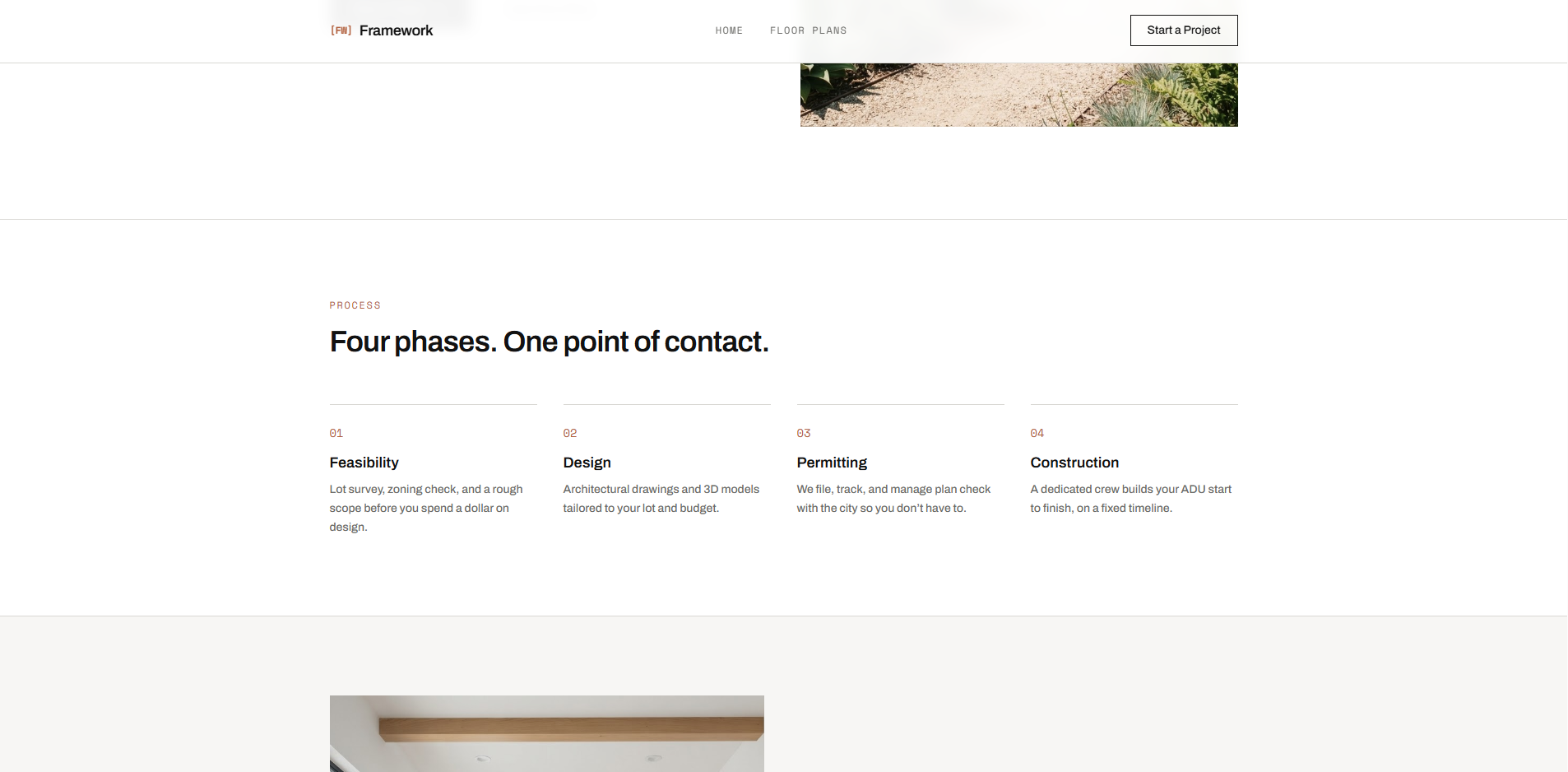
The four-phase process shown as core homepage content, not a footnote
The Design Approach
Architecture firm aesthetic, not general contractor. Clean grid lines reminiscent of blueprint drawings, generous white space, and a modern grotesk typeface position Framework as an architecture-led studio, which matters because ADU buyers are specifically choosing between architects, general contractors, and full design-build firms, and the site needs to make clear which one this is.
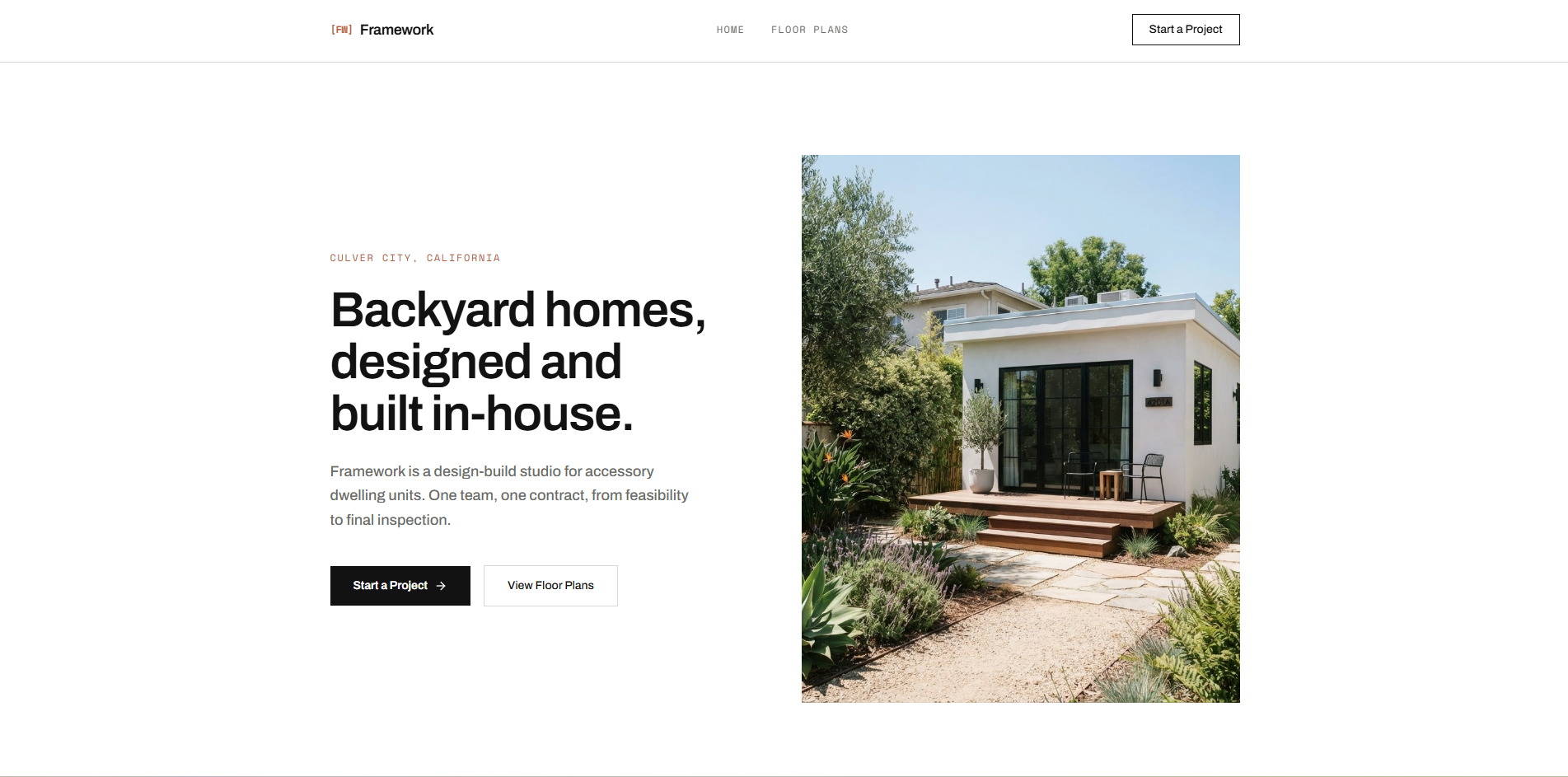
The hero is deliberately minimalist, white and black with a single terracotta accent and thin architectural line overlays, and a headline that immediately signals simplicity: “One team, one contract, from feasibility to final inspection.”
The process itself as the main content, not a footnote
A four-phase breakdown, feasibility, design, permitting, construction, is presented prominently on the homepage, because removing uncertainty about the process is more persuasive to this buyer than any amount of portfolio photography.
In-house positioning stated explicitly
"One fixed contract covering design, permits, and construction" and "in-house architect on every project" directly address the exact pain point that stalls most ADU projects, disconnected handoffs between separate design and construction firms.
Pre-designed floor plans shown as a shortcut
The inner page presents a handful of standard floor plan options with simple line-drawing graphics, giving anxious first-time buyers a faster, lower-risk entry point than a fully custom design process, and directly speaking to permitting speed, a huge concern in this category.
A project portal mentioned as a trust signal
Weekly progress updates through a dedicated portal reassure a buyer who's likely heard horror stories about contractors going dark mid-project.
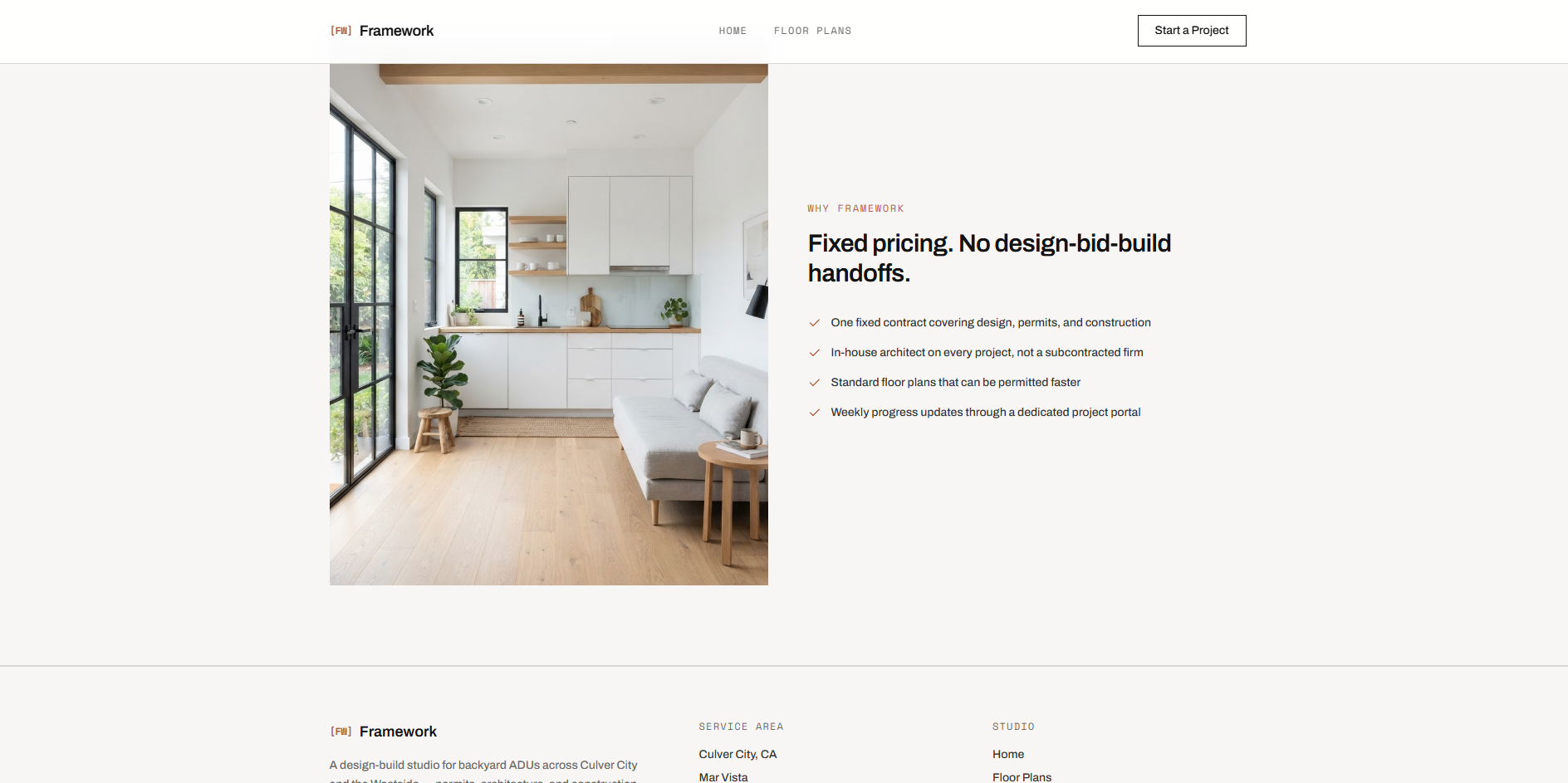
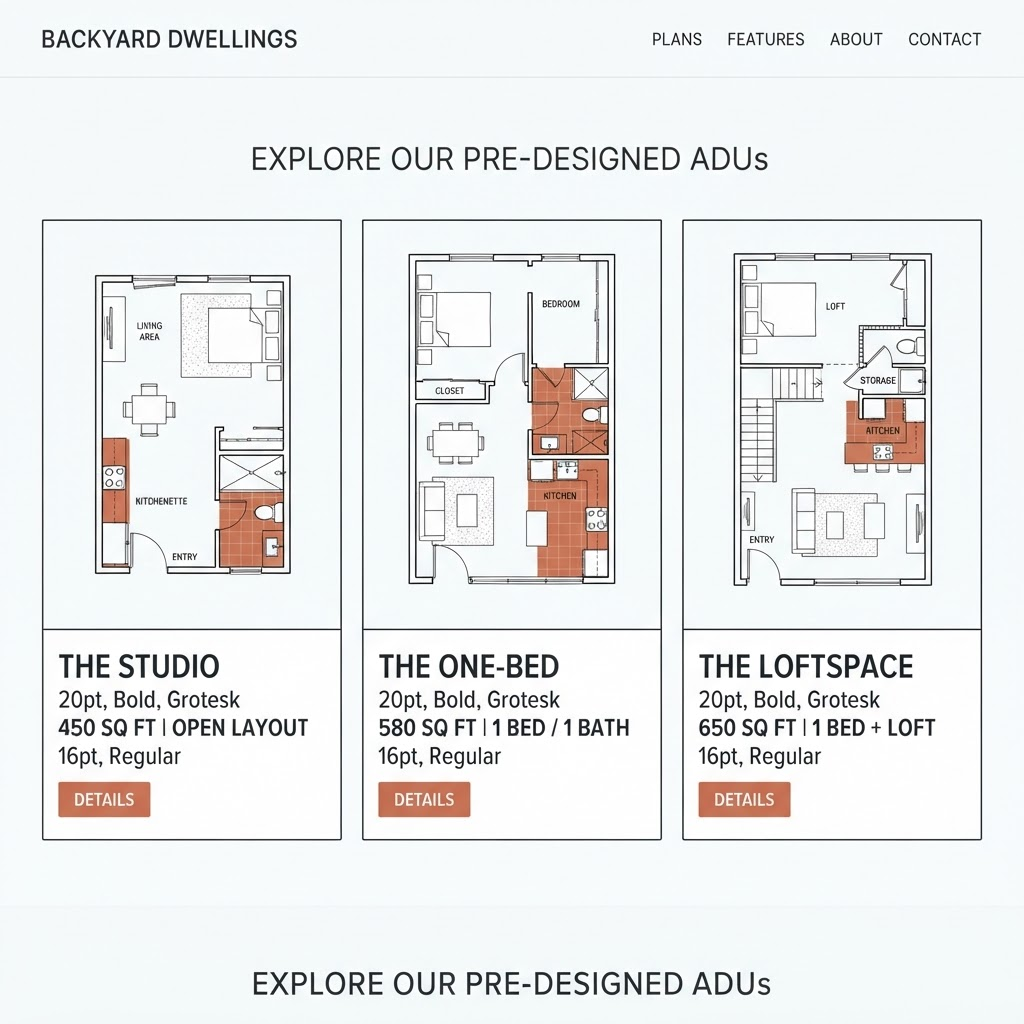
Fixed pricing stated plainly, and standard floor plans offered as a faster, lower-risk entry point
SEO Strategy: Riding a Genuine Local Demand Wave
ADU searches on the LA Westside are growing fast, and the keyword opportunity splits between people ready to build and people still trying to understand if it's even possible on their lot.
Core service terms
- "ADU design build Culver City"
- "backyard home builder Westside LA"
- "accessory dwelling unit contractor near me"
- "ADU floor plans Los Angeles"
Early-stage research terms
- "can I build an ADU on my lot Los Angeles"
- "ADU permitting timeline California"
- "ADU cost per square foot LA"
- "design build vs separate architect for ADU"
Trust and process terms
- "fixed price ADU builder"
- "ADU contractor with in-house architect"
- "fastest ADU permit approval Los Angeles"
The early-stage research terms are especially valuable in this niche, a large share of potential customers are still deciding whether an ADU is even feasible for them, and content that answers that question directly, rather than assuming the visitor is ready to sign a contract, captures them much earlier in the decision than a competitor's generic services page.
Ongoing Maintenance and SEO
ADU regulations and permitting timelines shift frequently across LA Westside cities, and much of Framework's search advantage comes from being the site that actually keeps that information current.
Ongoing maintenance for an ADU design-build site typically covers:
- Updating permitting timeline and cost content as city and state ADU regulations change
- Adding new standard floor plan options as they're finalized
- Monitoring rankings across all three keyword groups, service, early-stage research, and trust, since each reaches a different stage of the buyer's decision
- Publishing feasibility-focused content that answers questions homeowners are asking before they're ready to commit
- Reviewing which keyword group is actually driving consultation requests versus just traffic
The Takeaway
Framework's site works because it treats simplicity itself as the product being sold. In a category defined by confusing, fragmented processes, a site that visually and structurally proves “we've already solved that for you” converts a nervous first-time ADU buyer far better than a portfolio of finished units ever could on its own.
That's the same approach behind every site Lattice Local builds: identify the actual source of hesitation in a market, then design and write the site to remove it.
Selling into a confusing, multi-step process?
Your site should prove you've already solved the chaos, not just list your services.
If your category is defined by a fragmented process more than a finished product, generic service pages cost you trust before a visitor even reads your pricing. Let's build a site that removes the hesitation up front.
Start Your Project